ODL Presents at UCF AI Conference

The Office of Digital Learning (ODL) Chief Academic Technology Officer Robert Fuselier, Instructional Development Faculty Dr. Annette Jones and Liying Miao, and Instructional Technologist Christopher Riley presented recently at the University of Central Florida (UCF) Teaching and Learning with AI conference.
In their joint presentation, “Ctrl+Alt+Delete: Rebooting Pedagogy & Practice for Teaching with AI,” the group explored the present and future of artificial intelligence (AI) in instruction. They reviewed the processes and practices that faculty and instructional designers should main control of, the practices that should be re-examined for alternate pathways, and the actions and activities that no longer serve teaching and learning. They also provided an overview of how FSU is utilizing AI tools.
Jones and Miao enjoyed many opportunities to meet and interact with faculty members from other institutions. They were encouraged by the level of experimentation with AI and applications being explored by other colleges and universities.
“No one has a monopoly on using AI the best or knows really where the future is headed. AI only functions best when we as instructors and designers stay involved in the development and design process.”
– Dr. Annette Jones, ODL instructional development faculty
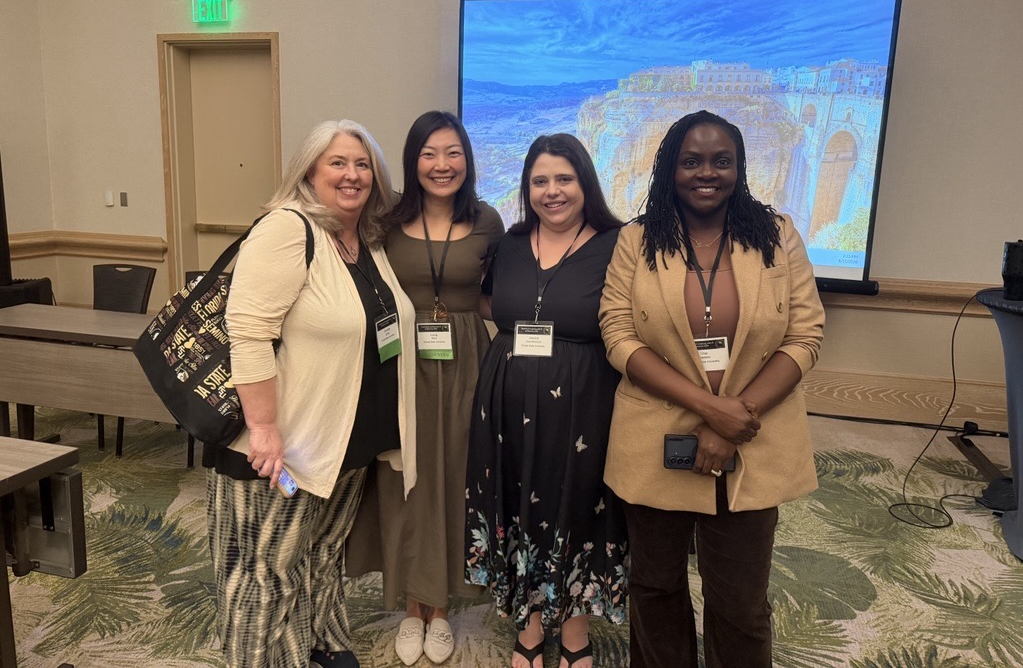
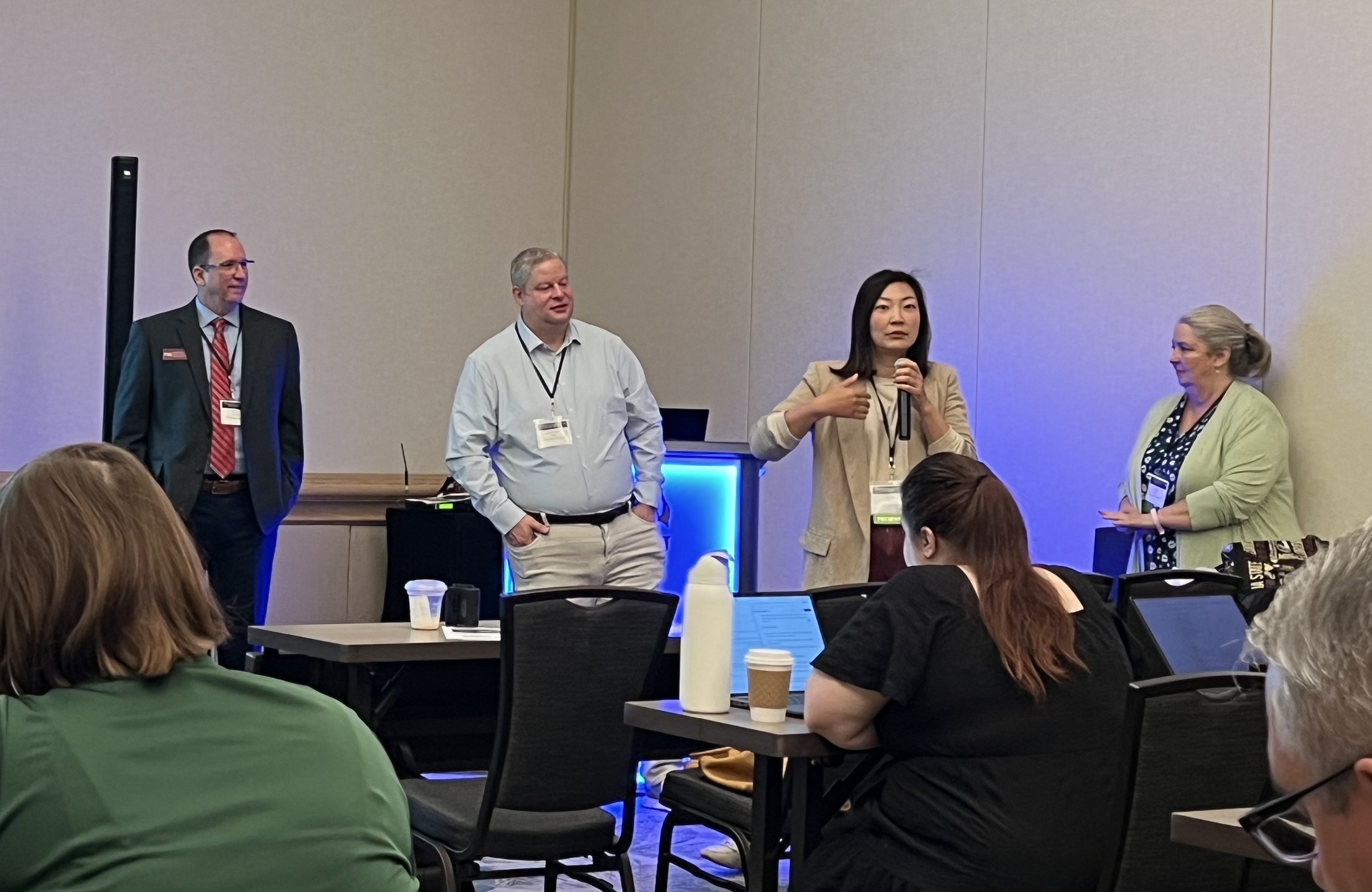
At left (L-R), ODL’s Dr. Annette Jones and Liying Miao connect with Jessica Greil-Burkhart and Ose Ndebbio from the FSU College of Social Work, who also presented at the conference. At right, Liying Miao discusses AI resources as co-presenters Robert Fuselier, Christopher Riley, and Annette Jones look on.
Jones attended the session of the FSU College of Social Work’s Jessica Greil-Burkhart and Ose Ndebbio and learned about their use of AI and scaling instructional design work. Greil-Burkhart and Ndebbio discussed how they utilize AI, along with faculty oversight, to align content and assignments with objectives and assessments over multiple courses.
Treating AI as a “critic” or Socratic partner emerged as a theme in several of the presentations Miao attended. In this usage, AI carries on a dialogue with a student about an assignment, prompting them to think deeply rather than providing the answer. AI becomes a learning tool, which encourages the student to reflect and gather evidence to support their response.
“The core message from the conference is that educators must actively shape how students use AI (not just whether they can) and reimagine cognitive domains for their own teaching,” Miao said.
The annual conference aims to equip higher education faculty and administrators with strategies for using artificial intelligence in education. Held in Kissimmee, Florida, the gathering welcomed representatives from over 200 institutions, with more than 1,200 attendees.
Top banner photo courtesy of the University of Central Florida.