Panelists Discuss AI Learning Activities
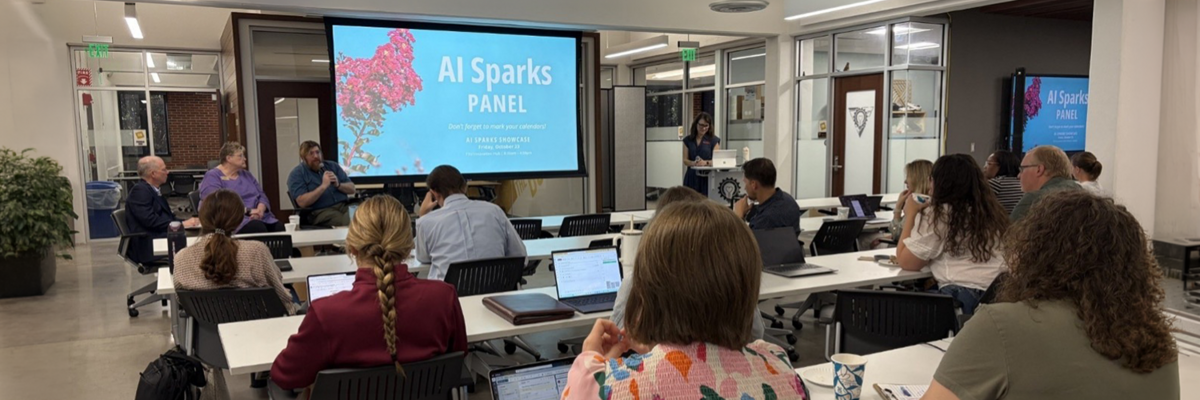
FSU faculty participating in the Office of Digital Learning’s (ODL) AI Sparks pilot program recently discussed their experience at the FSU Innovation Hub as part of the fall series of Faculty Innovator Coffee Chats.
The AI Sparks pilot program, launched earlier this year, is a campus-wide collaborative effort to integrate AI literacy and applied AI learning in undergraduate and graduate curricula. Over 25 FSU faculty from more than 20 academic disciplines participated in the pilot to develop AI Sparks, AI-based learning activities that are ready to use in Canvas and adaptable across academic disciplines. Applicable for online or in-person instruction, AI Sparks can easily replace existing learning activities without the need for substantive course redesign.
The panel discussion, moderated by ODL Assistant Director of Communications and Strategic Initiatives Kim Houghton, explored examples of AI Sparks, the insights of the faculty involved in designing and implementing them, and feedback from students who interacted with the AI activities.
Panelists included Laura Gayle Green, head of the Warren D. Allen Music Library in the College of Music; Dr. Chris LaFever, assistant teaching professor and career counseling program coordinator at Anne’s College; and Dr. Darren Brooks, assistant department chair, senior lecturer, and MBA program director at the Herbert Wertheim College of Business.
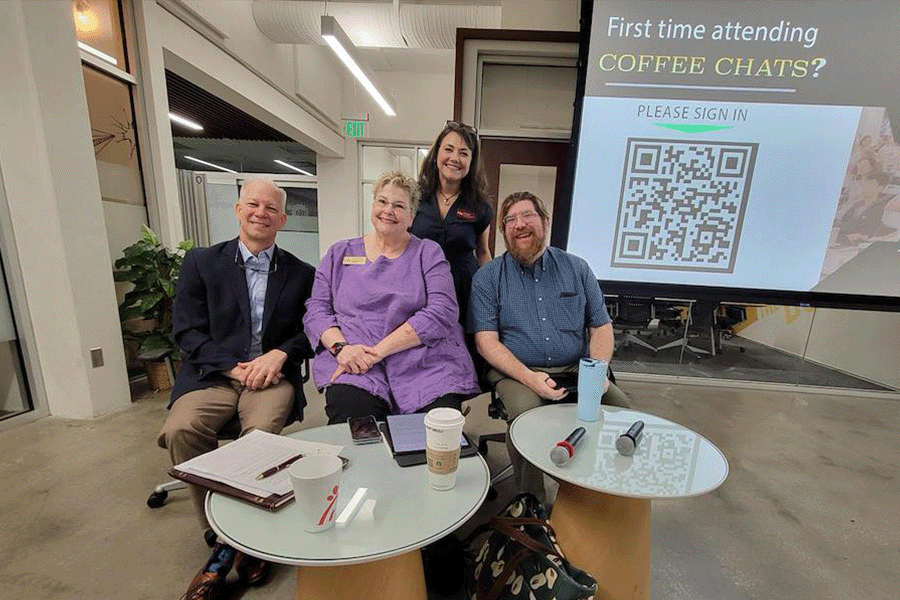
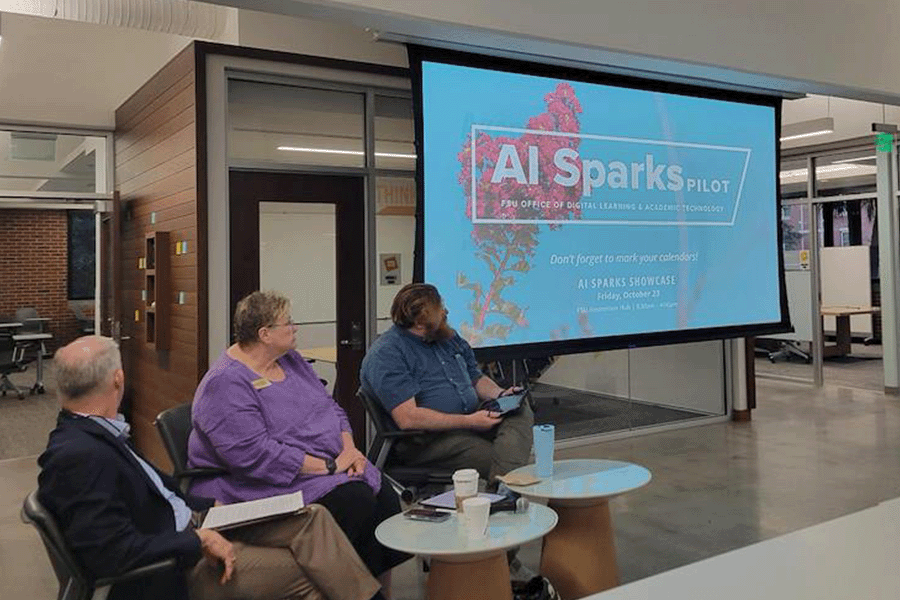
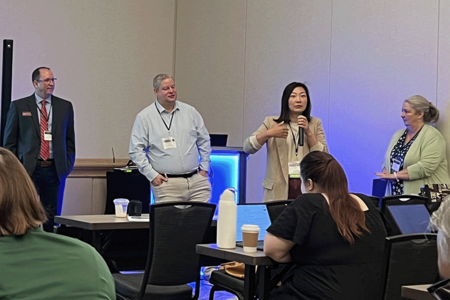
At left, Darren Brooks, Laura Gayle Green, Kim Houghton, and Chris LaFever gather for the AI Sparks panel, held at the FSU Innovation Hub as part of the Faculty Innovator Coffee Chats. At right, the panelists discuss their AI Spark learning activities.
Green’s AI Spark utilizes a custom Google Gem that acts as a writing coach for students in her graduate-level bibliography course as they develop “listening journals” recording their thoughts and feelings while actively engaging with various pieces of music. The Spark provides students with prompts and guided questions to encourage deeper introspection as they write.
“I’m a librarian first, and I always want people to explore and find information and answers themselves,” said Green. “[So] I chose a Google Gem.”
LaFever and Brooks both developed AI Sparks to simulate real-world interactions students may face in work environments.
LaFever created his Spark for an asynchronous, K-12 career readiness counseling course. In the activity, students interact with a Google Gem programmed to mimic a middle school student who is disengaged with course work. LaFever’s students are challenged to engage like they would in the workplace and counseling scenarios where they must build rapport with students and overcome resistance.
Brooks’s Spark focuses on teaching negotiation skills. The activity simulates purchasing a used car and takes students through the process of preparing to negotiate and then finalizing negotiations with a “self-interested seller.” Brooks has also been developing a series of additional Sparks that simulate other increasingly challenging negotiation scenarios.
“I had wanted to do something like this assignment for a while but staging it with vendors and utilizing in-person role-play partners was cost prohibitive, not robust, and not accessible for many students,” said Brooks. “Gems allowed for corrections for all these issues.”
LaFever echoed Brooks’s sentiment and added that Gems allow him to more closely control variables and avoid any misunderstandings that may occur about the specific goals for the assignment.



AI Sparks panelists (left to right) Laura Gayle Green, Chris LaFever, and Darren Brooks.
Student Feedback
According to initial surveys of students in courses where AI Sparks were implemented, 72 percent of respondents found their assignments to be both relevant and easy to understand, and 77 percent believed their experiences in courses with the AI activities will benefit them in their future careers. The panelists said that knowledge of interacting with AI tools and possessing critical judgment on using the tools will be among the most important skills for the workplace.
Helping students understand the limitations of AI was important for the AI Spark activity. Brooks said that his students reported to him on what the tool could and could not do, as well as discovering ways to play the tool to their advantage. The importance of human judgment when working with AI and not taking its responses at face value became an important takeaway for many students.
LaFever said his students expressed surprise at the experience and simulation overall. “Several (students) mentioned they had not thought about tailored skills for individual intervention and weren’t ready for the student resistance,” he said. “They appreciated those pieces and the challenge; they thought they were more prepared than they actually were.”
“I don’t think any of us had experience with AI coming into this project; we were all novices at different levels. A teaching mantra I keep returning to is this: be fearless when it comes to teaching. Try something new.”
Darren Brooks, Ph.D.
Herbert Wertheim College of Business
AI Sparks Showcase: October 23
On October 23, the inaugural AI Sparks Showcase will be held at the Innovation Hub, and the campus community is invited to join. Divided into two half-day events, the showcase features faculty presenting the Sparks they developed as part of the pilot. For more information, visit the AI Sparks Showcase page.
Looking ahead to the showcase, Green is eager to discuss her Spark with other faculty and discover how Sparks for one discipline can be adapted to meet the needs of another.
“I really enjoy seeing folks from all over the university in one place with a common goal,” she said. “There are so many colleges represented in this program, there should be something valuable for everyone.”