Powell Lauded with Online Teaching Award

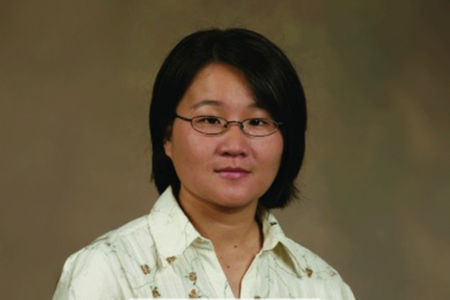
April Powell, teaching faculty at the School of Communication Science and Disorders in the College of Communication and Information, recently received the 2025-2026 University Teaching Award for Excellence in Online Teaching.
The University Teaching Awards recognize teaching excellence as multifaceted, involving areas such as positive role modeling for students, imparting respect for truth and a love of learning, and employing pioneering instructional techniques. The online teaching award recognizes outstanding and innovative instruction in distance learning courses. Powell’s online course SPA 5103 – Anatomy and Physiology: Speech, Language, and Hearing was recently certified as high-quality through the FSU Online Quality Initiative. The course passed a rigorous peer review using the nationally recognized Quality Matters rubric.
In the following interview, Powell shares her insights and instructional strategies for successfully navigating and enhancing online teaching.
Why do you like online teaching?
I enjoy the challenge! I have completed both on-campus and online graduate programs, and I know how easily online students can feel disconnected and discouraged. Over the years, I have minimized my focus on exams and quizzes and started focusing more on task performance. This motivates me to create learning environments where students feel supported, respected, and seen. My students range from post-baccalaureate learners entering a new field to graduate students preparing for clinical practice. Because of this, I enjoy the intellectual and creative challenge of designing courses that meet diverse needs while maintaining rigor and accessibility. My students also share their unique experiences and perspectives with me, so each iteration of my courses feels fresh and new.
What teaching tips would you have for instructors interested in teaching online?
First, I think it is essential for instructors to acknowledge that online learning should never be viewed as "less than" or inferior to a more traditional face-to-face learning experience. I do think, however, that it does require more creativity and careful time management.
Other important considerations include:
- Transparent structure and expectations: Clear organization, consistent navigation, and explicit learning support reduce anxiety and help students focus on learning.
- Intentional relationship building: Strive to know them as individuals, not just names on a grade roster. Regular office hours, flexibility in providing "on-demand" online or phone meetings, quick responses to student inquiries, and sustained contact across semesters help students feel supported and engaged.
- Purposeful technology: Select tools that genuinely enhance experiential learning and that students can use in other courses and in their profession(s).
- Inviting and using student feedback: Gather feedback throughout the semester and use it to refine activities and course structure. I am always tweaking my courses. Whenever possible, I give students options for how we'll conduct our synchronous sessions, the types of additional supplemental resources they'd like made available, and additional topics they may want to include.
- Differences between telling and teaching: I believe that teaching is something done with students, not to students. Students can read textbooks and access lots of material online. What value do I add to the course? How can I explain course content or provide examples so that students can have those "Ah-hah!" moments where concepts become comprehensible and memorable?
- Long-term thinking: Design courses not just to meet immediate objectives but to support students’ development as future professionals. I deliberately make connections between content in one course and content in other courses. I frequently remind students the point of my courses is not committing a lot of facts to short-term memory but building the knowledge and skills they will need to function as autonomous clinicians.
What is your favorite instructional strategy for online teaching?
I integrate clinical reasoning early and often, even in the prerequisite courses I teach. I focus on connecting the course content to real clinical examples, using guided problem solving during synchronous class sessions, encouraging students to articulate their reasoning aloud (or in the chat box), focusing less on right or wrong final answers and more on the reasoning process, and designing assignments and activities that are related to clinical activities.
How do you engage with students?
I try to engage with them in ways that work for them. I log on before class and stay online after class. Many of my students have demanding schedules and/or complicated personal lives, so I try to be very flexible in scheduling ad hoc office hours on evenings or weekends. I am fortunate to teach most of my students over multiple semesters, so I do get to know many of them relatively well. I also serve as a program advisor for our post-[baccalaureate] "Bridge" program. And, of course, it is important to provide personalized feedback and encouragement.
How do students engage with each other?
I try to encourage students to engage and get to know each other and foster a sense of community. We have class discussions, guided activities, collaborative group projects, and opportunities for peer feedback. I provide opportunities for students to share information about themselves and to get to know other students who share similar interests, geographical locations, professional situations, etc.
Assessments can sometimes be challenging in online courses. What strategies do you use for assessing student learning?
Over the years, I have minimized my focus on exams and quizzes. I now focus more on task performance, using a combination of formal and informal assessments in my classes.
Formal assessments include:
- Structured assignments aligned with standards set by our national credentialing agency, the American Speech-Language-Hearing Association (ASHA)
- Collaborative group projects
- Online laboratory activities
- Guided clinical observation reflections
Informal assessments include:
- Class discussions
- Peer feedback
- Individual meetings
- Mid-semester and end-of-semester feedback
Together, these methods allow me to evaluate both knowledge and professional growth.