Faculty Showcase Sparks AI Innovation
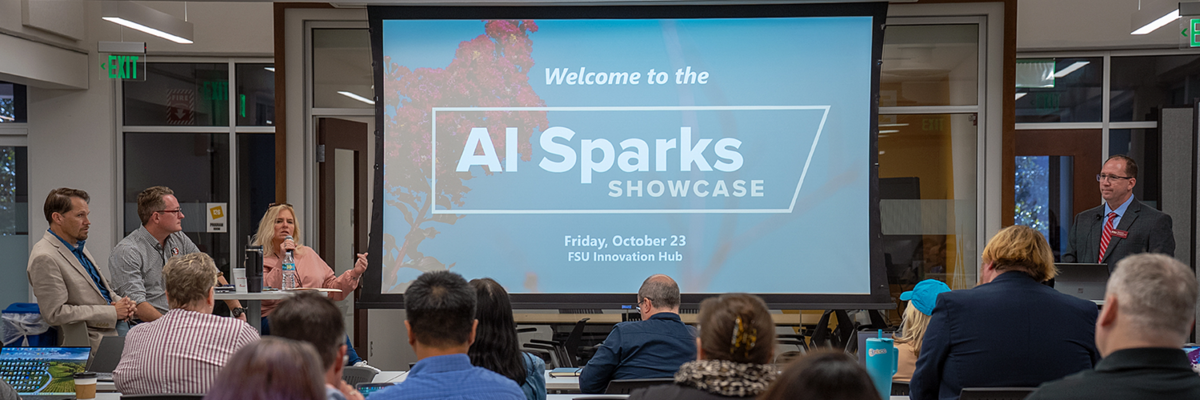
Browse the catalog of AI-based learning activities to explore how FSU faculty are applying AI learning in their courses.
AI Sparks Catalog >
From music to marketing and education to engineering, FSU faculty presented AI-based learning activities at the AI Sparks Showcase held at the FSU Innovation Hub in October.
Organized by the Office of Digital Learning, the showcase featured presentations from over 20 faculty, all focused on the learning activities they developed as part of the AI Sparks pilot, which launched in the spring. AI Sparks are AI-based learning activities that are ready to use in Canvas, adaptable across academic disciplines, and available to any instructor interested in integrating applied AI learning and literacy in their online or in-person courses.
At the daylong showcase, faculty demonstrated their Sparks, discussed how they developed and implemented the activities, and shared what they learned throughout the process.
“This was my first time using AI in a course, but the growth I’ve seen in students is already beyond my expectations,” said AI Sparks presenter Dr. Marina Girju, an assistant lecturer at the Herbert Wertheim College of Business. “Going forward, it will be a main tool in class.”
Girju’s Spark focused on implementation of a qualitative analysis where students develop AI tools to assist them with a marketing research project, data interpretation, and designing and conducting marketing research.
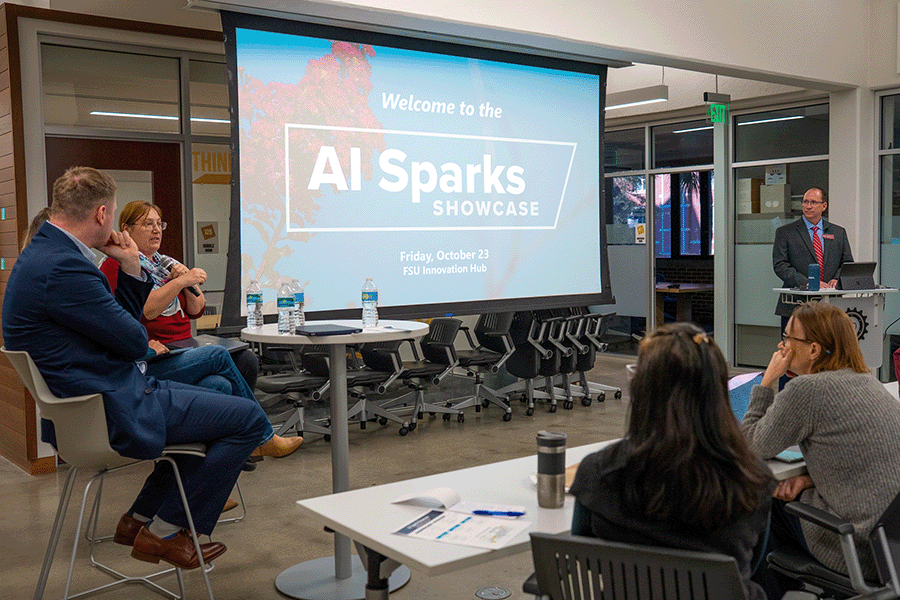
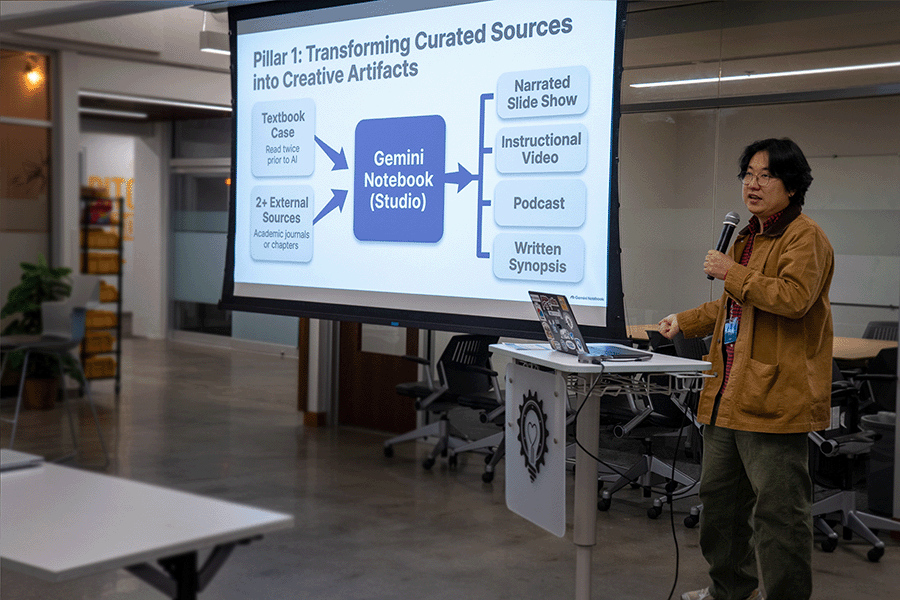
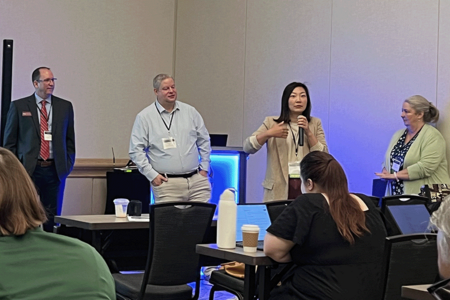
At left, presenters engage in a Q&A session about their AI Spark learning activities. At right, Dr. Gi Woong Choi of Anne’s College demonstrates his Spark.
For faculty who began implementing their AI Sparks during the Summer 2026 semester, student feedback has been enthusiastic. Over 80 percent of students found the assigned AI learning activities were relevant to the course, and over 75 percent believed AI skills would be necessary in their future careers and would benefit them post-graduation.
“I enjoyed the simulation activities with a prompt and working through a conversation. The feedback at the end was helpful to see areas I could improve on. More of this would be great!” said one student. Another shared that the activities were “really fun and interactive and completely different than anything I have ever done before.”
During the showcase, faculty discussed students’ AI fluency coming into courses and how to prepare them for successful engagement with the assignments.
“Teaching students how to write prompts is essential. Another step is to teach students to move away from chatbots,” said Dr. Dania Tawfiq, an assistant teaching professor at Anne’s College. “If you want [students] to really learn how to take advantage of all toolsets that professionals use, you have to be proactive.”
Tawfiq presented her Spark, “The Reasoning Coach,” which addressed the instructional gap that can occur when students are able to recognize course concepts but have difficulty using those concepts to interpret complex developmental experiences, evaluate evidence, and explain their reasoning.
“This was my first time using AI in a course, but the growth I’ve seen in students is already beyond my expectations. Going forward it will be a main tool in class.”
- AI Sparks presenter Marina Girju
Several presenters cited limited experience with AI when they began developing Sparks and learned about the technology’s strengths and weaknesses alongside students. This acknowledgement was reassuring to attendee Brigitte Gudz, an InSPIRE STEM specialist with the Learning Systems Institute.
“The thing that surprised me most was that even the college professors that were using this now are still novices,” said Gudz. “Some of them know, really, what they’re doing, but a lot of them were open enough to say that they were still learning to do this too. So, it made me feel a little better about being an extreme novice.”
Li Yeoh, director of piano technology at the College of Music, was enthusiastic about attending the showcase. “I wanted to learn more about how AI tools can help students to create music and, at the same time, help with all the technical challenges at the piano lab at the College of Music,” he said. “One of my takeaways is that AI could be a really good mentor that can spark curiosity, rather than a replacement for hands-on learning.”
For colleagues who might be hesitant about AI usage, presenters emphasized the opportunity for exploration and collaboration across academic disciplines. “Until I walked into AI Sparks, I had no idea about Gemini or Gems. I would encourage [experimenting with the tools],” said Dr. Laurie Lawrence, teaching faculty at the College of Applied Studies.
Dr. Michael Strickland, specialized faculty member at the College of Music, agreed with encouraging colleagues to explore AI.
“You’re already using it; it’s just a change in interface. Don’t be afraid of it,” he said. “You already have a ton of teaching experience and learning knowledge. Your ability to evaluate is already there. We’re just learning to adapt.”
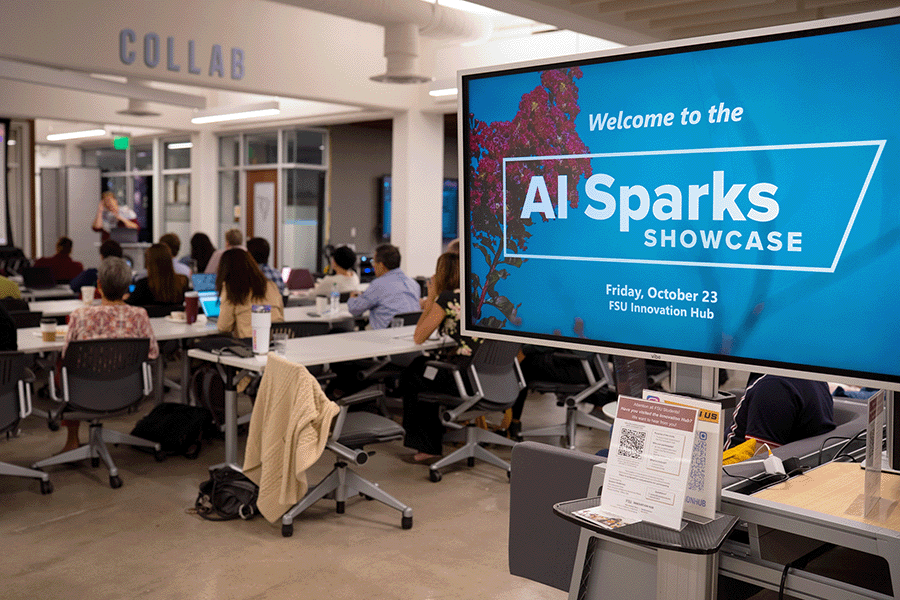
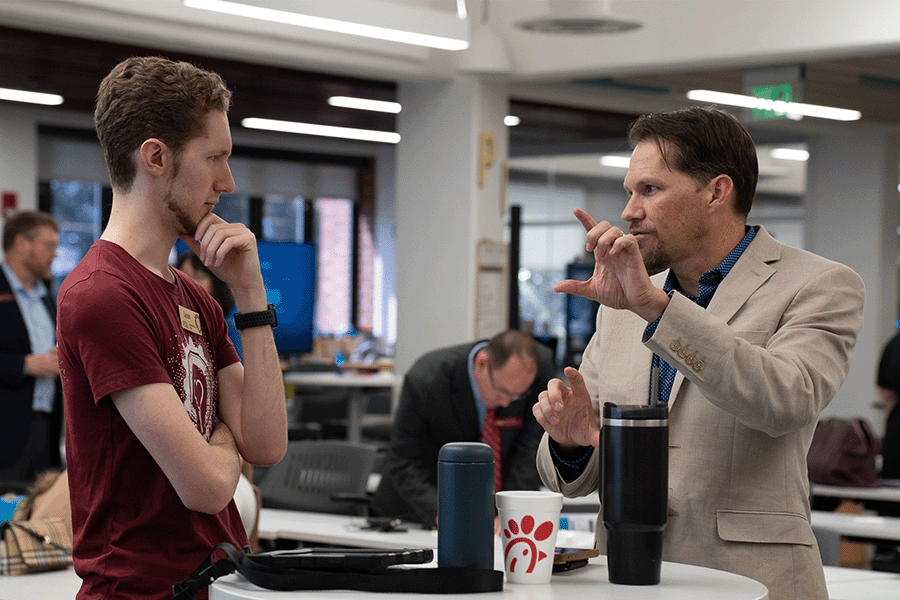
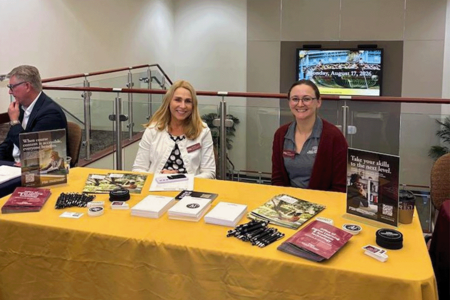
At left, attendees are welcomed to the AI Sparks Showcase at the FSU Innovation Hub. At right, AI Sparks presenter Dr. Michael Strickland (right) chats with Jason Hamilton, graduate assistant with the Hub.