Integrating AI Literacy in FSU Coursework
“I feel more inspired and motivated.
A year ago, I was dead set against AI,
but now I’m committed to exploring ways to teach with it as a tool and not deal in absolutes. I’m definitely walking away with more resources and ideas.”Laurie Lawrence, PhD
Professional Communication, College of Applied Sciences (FSU Panama City)
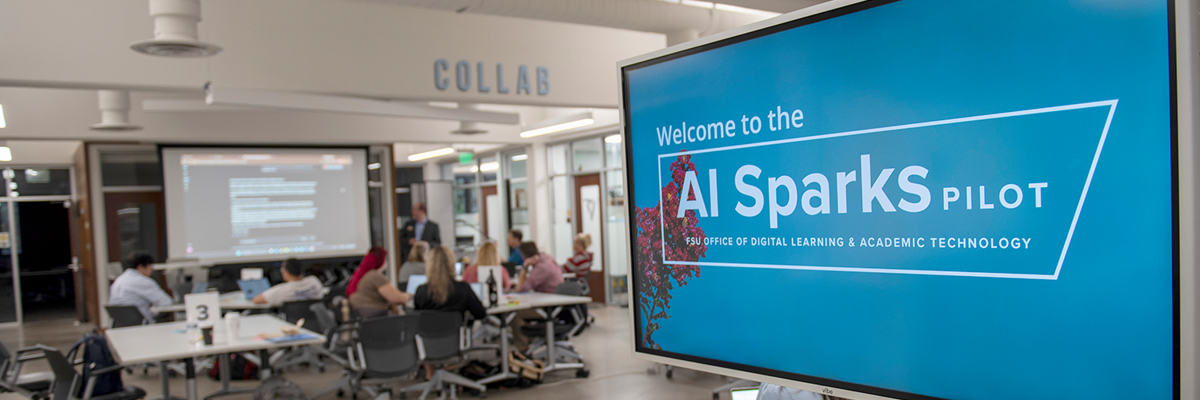
With the goal of integrating AI literacy and applied learning in undergraduate and graduate curricula, the Office of Digital Learning (ODL) launched the AI Sparks pilot program in the spring. Faculty participating in the pilot program are developing AI Sparks, AI-based learning activities that are ready to use in Canvas and adaptable across academic disciplines. AI Sparks, which are applicable for online or in-person instruction, can easily replace existing learning activities without the need for substantive course redesign.
As part of the AI Sparks pilot, ODL facilitated design-thinking sprints in late May and early June. The FSU Innovation Hub hosted the events, which included faculty from the Tallahassee and Panama City campuses with various levels of AI experience. Participants represented a range of disciplines, including education, business, music, mathematics, engineering, physics, nursing, social work, and entrepreneurship.
Innovation Hub Founding Director Ken Bauldauf provided an orientation on design thinking and how it can be used to approach the development of AI-based learning activities. The sprint offered faculty a collaborative space for conceptualizing and building their AI Spark activity. ODL Chief Academic Technology Officer Robert Fuselier – along with Associate Vice Provost for Academic Innovation Dr. Paul Marty and ODL Instructional Designer Damilare Ajayi – conducted demonstrations on Gemini, Gemini Gems, and Notebook LM, the three AI tools faculty would use to build their AI Spark.
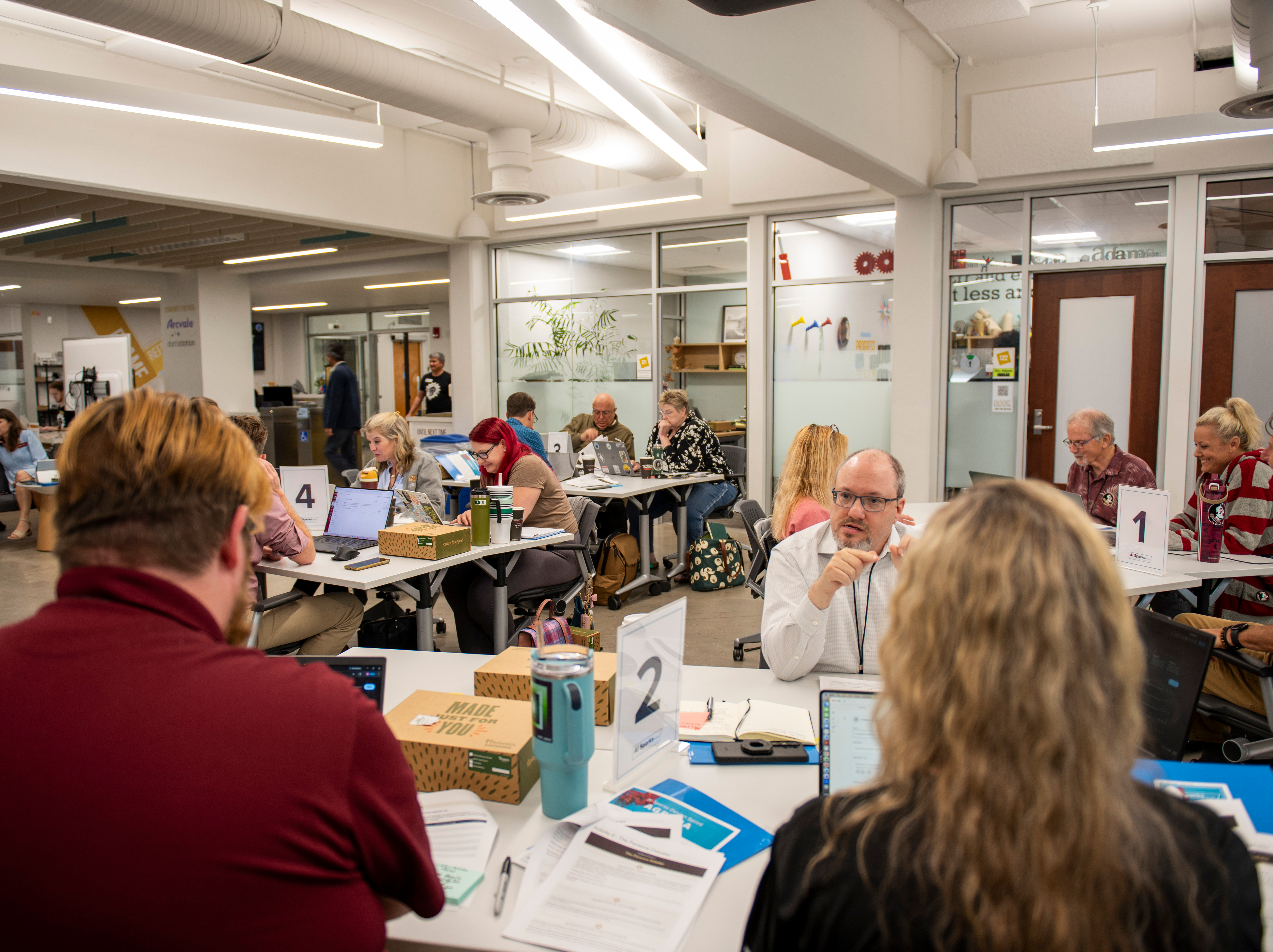
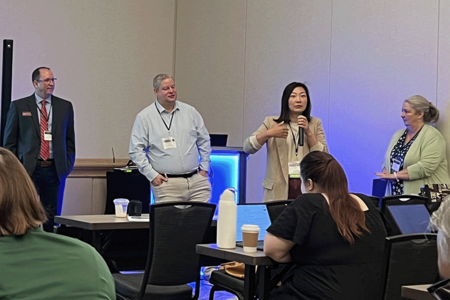
At left, ODL Chief Academic Technology Officer Robert Fuselier demonstrates how to use AI tools for the activity. At right, faculty collaborate in small groups.
To demonstrate the application of AI Sparks in different course types, ODL provided 10 example AI Spark activities. These examples, which ranged from AI as a Socratic tutor, interview simulator, or peer reviewer, helped faculty accelerate the design process and illustrated how to use AI to deepen student understanding and skills. In the literary analysis learning activity, students read a passage and interact with a custom AI persona that asks questions about the passage. The conversation continues until students discover aspects of the text they may not have noticed on the first reading.
Participants divided into teams to work on individual and group AI Spark design. A group debrief allowed them the opportunity to discuss their ideas and the progress they made developing their AI Sparks. Potential uses for the activity ranged from enhanced peer reviews to making tests more accessible to ethics training.
“Employers want students to know how to use AI in the workplace. Incorporating AI instructional assignments into our coursework will not only prepare our students for their future endeavors, but when done right will teach students how to use AI to think deeply and not just to use it as a shortcut.”
Katie Flanagan, PhD
Department of Sport Management, Anne’s College
Several participants focused on the value of learning what their colleagues are planning for their AI Spark activity.
“I went from an idea I wanted to implement to pivoting entirely,” said Dr. Harrison Pugh of the School of Marketing in the Herbert Wertheim College of Business. “Getting together (with other faculty) empowered me to shift because someone else was working on something similar to my original goal. It’s always nice to get together with a big, interdisciplinary group of thinkers.”
Laura Gayle Green, head of the Music Library at the College of Music, agreed. “It was very helpful to hear from other folks and how they apply AI in their courses. It was both an affirmation in my own plans and an inspiration for other potential applications.”
At the end of the sprint, participants turned in reflection worksheets outlining their AI Spark and goals for implementation. “I was so eager to begin working on implementing [the AI Spark] in my class,” said Dr. Katie Flanagan of the Department of Sport Management in Anne’s College. “I have already created my first test assignment and am making plans to use former students who have taken the class to test the assignments.”
Faculty will deploy their AI Spark in a Summer or Fall 2026 course and gather feedback from students about their experience with the learning activity. If they choose, faculty can present their findings on the effectiveness and impact of their activity at an AI Sparks showcase in the fall.

At left, FSU Innovation Hub Founding Director Ken Baldauf chats with a faculty member. At right, faculty focus on developing their AI Spark.